

INTRODUCTION
This section sets out the water safety policy of London Rowing Club and must be adhered to by all members. Information within this section explains how risks can be mitigated and what actions to take in the advent of an issue.
All members of the club must view safety on and off the water as their first priority. It is an issue managed at Committee level and is the first agenda item of all meetings, decisions are taken by the Committee and must be adhered to by all members. The Club Rowing Safety Advisor advises the Committee and members on safety on the water. Safety within the club building is overseen by the Hon House Steward. Questions or concerns can be raised to the Club Rowing Safety Adviser (CRSA) via safety@londonrc.org.uk and all references within the safety documents to reporting to the CRSA should be sent to this email ID.
MANDATORY DOCUMENTS FOR ALL ROWERS, COXES, COACHES & OFFICIALS TO READ:
Make a risk assessment
Rowing on the Tideway
Guidance for Rowers and Canoeists on shared water
Safety plan
HAZARDS, NAVIGATION RULES, CIRCULATION PATTERNS, EMERGENCY ACCESS POINTS
REPORTING INCIDENTS
EMERGENCY CONTACTS AND EQUIPMENT, INCLUDING TELEPHONES
RULES AND RESPONSIBILITIES
Annex 1 - EMERGENCY ACTION PLAN
Annex 2 – STEERS POLICY
Annex 3 – ANY OTHER POLICY
All boating is in accordance with the club Bye-laws found in the Governance section of the website: London Rowing Club – The Tideway's Home of Successful Sculling and Rowing (londonrc.org.uk)
1 . HAZARDS, NAVIGATION RULES, CIRCULATION PATTERNS, EMERGENCY ACCESS POINTS
All steers and coaches must be familiar with The Tideway Code and navigation rules contained within.
A copy of the circulation pattern, including key hazards and emergency points is located on the ground floor water safety notice board.
Every launch driver, steers and crew should complete their own risk assessment prior to boating. This can be as a group prior to mass boating, but individual steers retain their autonomy when judging safety. See Section 4. & Annex 2 for further details on steers responsibilities.
Hazardous conditions
The following situations should be carefully considered in the pre-outing risk assessment and may force the cancelling of an outing:
● Heavy fog (where the Fulham wall is not visible from the Embankment) and other low visibility
● High winds
● PLA warning flags (see below)
● Thames Barrier lowered
● Extreme temperatures
● Thunderstorms/lightning
● Extremely high/low tide predicted
● Dark and low tide
● Tide/stream direction changing
● High levels of debris / new obstacles
● Levels of traffic and exclusions during working hours of River Transport Services and Barges
● The club Bye-laws restrictions on boating
PLA Warning System
All steers and coaches must be familiar with the PLA’s flag status before boating. This can be found on the PLA website and experience will aid you to apply these as part of your risk assessment. Updates will be circulated to steers as the situation changes.
RED = Extreme Caution – very strong fluvial flows. LRC policy on a Red Flag is that you must check with the Club Rowing Safety Advisor before boating during forecast Ebb tide times at Safety@LondonRC.org.uk Boating will be severely restricted in area and to strong Expert crew boats and strong Expert scullers.
YELLOW = Strong fluvial flows, beginner crews and their coaches must take extra care on the Ebb tide if it is deemed safe to boat
GREEN = Navigate with caution and maintain a good look out
BLACK= Fluvial flow is less than usual and lower than predicted tides are expected. Navigate with caution at low water; do not boat at low tide in club shells.
2. REPORTING INCIDENTS
All members are responsible for reporting incidents (see Rules and Responsibilities). Incidents must be reported as soon as is practical to the CRSA via Safety@LondonRC.org.uk.
All incidents will be reviewed by the CRSA who will take the decision to escalate to the club Committee, British Rowing, or the PLA where necessary. Actions required will be agreed by appropriate Officers of the club and Section leads.
3. EMERGENCY CONTACTS AND EQUIPMENT, INCLUDING TELEPHONES
In event of an emergency call 999 and ask for the required service (request Coast Guard for on the water emergencies). The address of the club is ‘London Rowing Club, Embankment, Putney, SW15 1LB.’
Club officials' contact information can be found in the office and on the water safety notice board.
Equipment
A defibrillator can be found on the LRC outdoors wall along the Spring Passage.
First aid kits can be found in gym, behind the bar, and on the landing outside the changing rooms. Please ensure any item taken from the first aid kit is reported to facilities@londonrc.org.uk and all incidents requiring attention are recorded in the accident book/s, located next to the external door by the lift (water related incidents) or behind the bar (land based incidents).
Throw bags are located in each launch and should not be removed. Any use of the throw bags should be reported to the CRSA and Chief Coach. Throw bags will be checked after each use and annually as part of the club safety audit.
Launch Safety Kit and Paddle
No launch may go afloat without a safety kit and paddle. Safety kits will be checked after use and annually as part of the club safety audit. Use of the safety kit should be reported to the CRSA.
Lifejackets are required for all coxes and launch drivers/passengers. Lifejackets are found in the equipment room next to the ground floor disabled lift. Self-inflating life jackets must not be used in bow loading boats – the method of inflation is marked on the reverse side of the lifejacket. Any deployment of a lifejacket must be reported to the CRSA. New laws from the Maritime and Coastguard Agency state that self-inflating lifejackets must be serviced every 12 months by a service station for which for which OEM [Original Equipment Manufacturer] approval or accreditation certification has been issued.
If a member has concerns about a specific club lifejacket this should be escalated immediately to the CRSA. The vest in question should not be relied on as functional and must labelled as such. Anyone using their own personal lifejacket takes on responsibility for testing and ensuring that it is in good working order.
Additional heel restraints, single hand release line, and bow balls can be found in the workshop. It is the responsibility of each crew to check these items along with the integrity of hull and other fittings before boating. Please contact fleetrepairs@londonrc.org.uk for access to parts.
A hypothermia prevention box containing dry clothes can be found inside the stores room. All use resulting from an incident on the water must be recorded in the incident book and reported via the British Rowing online system. Bags are checked yearly at Club Pride Day.
4. RULES AND RESPONSIBILITIES
Responsibilities of all members and coaches
Each member has a responsibility to ensure the safety of themselves, their crew and other river users. Every launch driver, steers and crew should complete their own risk assessment prior to boating, this can be as a group prior to mass boating, but the individual steers retain their autonomy when erring to the side of safety. All members are expected to be familiar with and/or comply with:
This Club Water Safety and Emergency plan;
and all reasonable instructions from the Captain, Coaches and CRSA.
Failure to so do may result in suspension of steering and/or boating privileges, including privately owned boats.
Launch drivers
No launch driver is permitted to go afloat without a kill cord. Kill cords must always be used and secured to the driver before any attempt to start an engine. Launch drivers must wear a suitable lifejacket or personal floatation device (PFD) when on the water. Launch drivers must be LRC members. Any launch driver paid for their work must hold a RYA 2 power boat certificate. Voluntary drivers must have been given training by a qualified or suitable instructor and be familiar with how to perform a rescue from within the launch (see Emergency Action Plan) and the Tideway Code. LRC members who wish to become voluntary drivers must fill out the following form: https://forms.gle/wPBkhWCzn6ECAhGp9 All launch drivers must carry a mobile phone with substantial charge in a waterproof pouch on their person.
Steers of crew boats (and their crews)
Steers have legal responsibility for their crew. Coaches and other crew members must respect this at all times and should not ask or encourage a Steers to perform any activity or take any action that is unsafe or violates the Tideway Code. Steers have a responsibility to ensure that safety of all crew members and must raise concerns if they are asked to do something that is unsafe.
Steers policy
All steers must be accredited by LRC and can only boat in conditions appropriate to their accredited level, or if accompanied by an Expert coach who has carried out and discussed a risk assessment to ensure that conditions are safe. It is the responsibility of the individual member to ensure their level and in-person auditor is recorded by the Club Rowing Safety Advisor. Steers levels may be found on MyClubhouse -> My Profile -> Approved Steers -> your steers level.
The Steers Policy and Levels can be found below, in Annex 2.
All steers including scullers must have a mobile phone secured to them or the hull in a watertight pouch to enable the summoning of aid, if required. Any steers seeing or suspecting another crew or sculler in distress should offer assistance or guidance, but should not risk their own or their crew’s personal safety.
Rowing at night
Rowing at night adds substantial risk and is therefore restricted to:
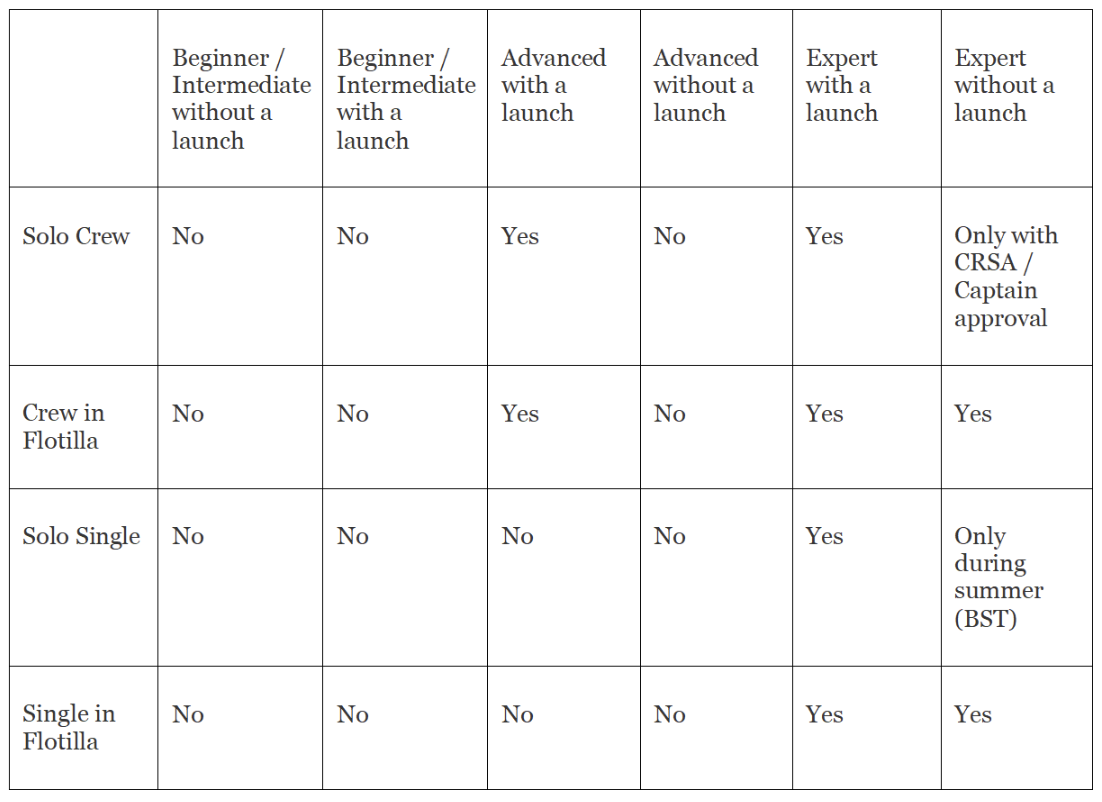
* Crew: 2x/2- and larger
* BST: British Summer Time (UTC+1)
* Flotilla: must remain within shouting distance
* Night: between sunset and sunrise, check your favourite website
No rowing boat should navigate below Putney Bridge after dark under any circumstances.
Lights
All rowing boats are required to have FOUR working white lights attached to the boat canvas (steady beams on the stern, flashing beams on the bow). Crews without sufficient lighting must not boat. All launches are equipped with a lighting bar that must be fixed and checked prior to going afloat in poor light and in any circumstance where visibility may become poor.
Annex 1
EMERGENCY ACTION PLAN
In the event of capsize, immersion, collision, ill health or equipment failure, the first priority must be for all involved to be moved to a place of safety and out of the water.
If a member of a crew is ejected from the hull following a crab the crew must immediately cease rowing and manoeuvre the hull towards the casualty.
Swamped hulls, if rowable, should be rowed to the nearest safe shore to be emptied. Shells will not sink if hatch covers are correctly fitted, and air compartments are present and intact.
The safest course of action in the event of capsize is nearly always to stay with the boat. In the event of capsize the crew should follow the guidance in the British Rowing Row Safe document (section 3.7), read this now. Use the capsized boat as a floatation device to reach the shore. In cold weather be sure to get as much of your body as possible out of the water. Everyone should be aware of the impact of cold water immersion, https://rnli.org/safety/know-the-risks/cold-water-shock
Do not attempt to paddle directly to the shore, instead aim for a diagonal point in the direction of the prevailing stream and consider hazards downstream of your location. In exceptional situations when being swept towards a hazard, an oar or pair of sculls will provide limited buoyancy when removed from the gate.
In all situations all crew members should attempt to stay together until safe.
Use of safety launch for a rescue
Extreme care must be taken in performing rescues using a launch. This should only be as a last resort as our launches are not designed to rescue casualties and are at severe risk of being tipped and filling. If there is no alternative except to attempt a rescue, launches should be loaded from the BOW to avoid capsize. If attempting a rescue, the engine must be turned OFF and extreme care taken near the propeller even with the engine off. In cold weather or if unwell, individuals removed from the water should be taken to the nearest open boathouse.
In any situation where there are multiple people in the water or in cases of unconsciousness or severe ill health, the launch driver should alert the Coastguard on 999. The RNLI launches are better suited to rescues.
All launch drivers have a responsibility to go to the aid of anyone in need, not just members of LRC.
Hypothermia
Hypothermia is a serious concern after a capsize and can be serious if not treated. Hypothermia is a drop in body temperature below 35C (normal temp is around 37C). Early symptoms include:
● Shivering
● Cold and pale skin
● Slurred speech
● Fast breathing
● Tiredness
● Confusion
If unsure, call 999. NHS advice on first aid for hypothermia is to follow these five steps:
1. Move them indoors
2. Remove wet clothes and dry them
3. Wrap them in blankets
4. Give them a warm non-alcoholic drink (if they can swallow normally)
5. Give them food that contains sugar (if they can swallow normally)
Avoid the following actions:
● Do not put them in a hot bath
● Do not massage their limbs
● Do not use heating lamps
● Do not give them alcohol
Hypothermia can happen in cold weather without capsizing. Dress appropriately for the weather.
Annex 2
STEERS POLICY
Tideway Steering at LRC: Updated 2026
Our obligations
● The PLA requires all Tideway clubs to have an Authorised Steers Accreditation System in place. Any coach, cox or steers must have completed an appropriate steering and navigation test to prove their understanding and knowledge of the Tideway Code. For accreditation, they must prove their competence to steer and show an understanding that the Tideway is often fast flowing with strong tidal sets. Accreditation must be given by a suitably qualified person and clubs must keep an up-to-date record of accredited steers.
Steers accreditation process
Members wishing to apply for steers accreditation should first contact their squad organiser, listed below. Private scull owners who wish to boat at their own discretion should contact the CRSA: safety@londonrc.org.uk
The accreditation process starts with (1) The LRC self-certification form, followed by passing (2) The LRC Tideway Code online test. The final step (3) is to contact your group lead and the CRSA, to ask your group lead to sign off on your self-assessed steers level. Otherwise, contact the CRSA to schedule an on-water assessment.
The form is a self-certification of your level. The level declared should be candid and relevant to the candidate’s boating at LRC.
The online Tideway Code (and other aspects regarding boating from LRC) test has a pass mark of 50 out of 56:
This is an open file test. Candidates should consult the Tideway Code, the club bye-laws and the water safety and emergency plan when completing their answers. The PLA site has the Ebb tide flag and tide times and is a useful page to store on your browser:
Each group at LRC has an organiser/leader who is responsible for ensuring members of their group are categorised, acting in a safe manner and obeying the navigation code. Group leads will escalate concerns or seek advice from the Club Rowing Safety Advisor (CRSA) when needed, and will be a point of contact for the CRSA on any issues. Group leads are responsible for ensuring anyone within their group is accredited to steer at the appropriate level and that lists are compiled and sent to the office to be held/updated as required.
The list of squad organisers is below (please notifying the WSA with any changes)
Irregulars: Eddie Markes / eddie.markes@londonrc.org.uk
Masters: Saskia Gill /saskia.gill@londonrc.org.uk (women) and Jason Bowyer / jbowyer08@gmail.com (men)
Squad: Stuart Heap / chief.coach@londonrc.org.uk and Killian O’Shea / killian.oshea@londonrc.org.uk
Young Irregulars: Kathleen Curran / Kathleen.Curran1@btinternet.com
Water Safety Advisor: Rui Xu / safety@londonrc.org.uk and Julia Robey / james_julia@icloud.com
Matthew Reeder (captain@londonrc.org.uk) may also sign off steers.
LRC STEERS LEVELS/PERMISSIONS
Beginner
Allowed to steer a boat in benign conditions only when accompanied by a coaching launch with an approved coach. The coach will take responsibility for the behaviour and safety of the steersperson (although legal responsibility always rests with the steer).
The coach must be someone approved by the ‘squad organiser’ and be deemed a Tideway
Requirements:
None
WHO IS COVERED AND WHAT YOU NEED TO KNOW
Anyone below Intermediate will be classified as beginner until they qualify for the next level (see below).
No beginners should steer in the dark, during wind, fog or strong/unusual tides, no matter the level of other crew members or coach.
No beginners crews will row downriver of Putney Pier.
All beginner crews must have a safety launch with them. This should be 1:1 for crews with beginner steers (including coxes). All crews must always remain within sight of the coaching launch.
A beginner may go out in a double with a tideway expert if they have permission of an appropriate person (see below).
NOTE: beginner crews carry a higher level of risk than other crews as those rowing will lack the skills and awareness to get out of trouble if required, therefore the steer level of the steer does not set the boating permission level.
LRC STEERS LEVELS/PERMISSIONS
Intermediate
Allowed to scull unaccompanied in accordance with the rules base in the Water Safety plan.
Allowed to steer/cox a crew boat during sessions with appropriate safety launch cover or if accompanied by a Tideway expert in the boat (safety launch can be supervising multiple crews) in daylight and good conditions.
Allowed to cox a crew containing Tideway experts (at least half crew) without a launch in daylight and good conditions.
No intermediate crews will row down river of Putney Pier.
Requirements:
● Is familiar with the Safety and Navigation documents required by the club, the PLA, Tideway Code and the BR Row Safe document)
● Given a water safety and navigation induction by a Qualified Coach or CRSA
● Coaches/Squad Organiser are satisfied the person can:
● Work out which way the river is flowing and be aware of how this affects navigation
● Cross the Tideway quickly and safely
● Aware of obstacles and hazards
● Has the physical and technical skills required to manoeuvre and control the boat
● Previously been signed off within the club steers accreditation process at the level of Intermediate
WHO IS COVERED AND WHAT YOU NEED TO KNOW
Beginners can move up to Intermediate once they have filed the online self-certification form, passed the online test, and been signed off by a member of the Rowing Sub-Committee. New rowers are expected to have rowed a full season before moving up.
All new club members that have at least two years rowing/coxing experience can pre-qualify as intermediate once their competence and Tideway knowledge has been verified by an appropriate person.
LRC LEVELS/ PERMISSIONS
Advanced
Is competent to scull and steer a boat without a launch present, in accordance with the rules base in the Water Safety plan, and provided there are no prevailing adverse conditions, examples of which are:
● When it is dark or is about to become dark
● When there is a very strong stream running
● If there has been a severe weather warning
● If there are white horses on the water at the beginning of the outing
● When the Fulham wall is not visible through fog
An Advanced steers is expected to recognise these conditions and can boat if it is deemed safe, but must be accompanied by a launch (to a sensible ratio for the conditions).
Requirements:
● Satisfies all requirements above (at Intermediate)
● Has successfully steered/sculled supervised on the tideway over a number sessions in various conditions
● Is deemed to have the skills as a rower/sculler/cox to cope with a variety of condition by an appropriate person or squad organiser
● Previously signed off within the club steers accreditation process at the level of Advanced.
WHO IS COVERED AND WHAT YOU NEED TO KNOW
Anyone steering the tideway for the past 2 years or more that has been signed off by a coach as competent can pre-qualify as Advanced.
Intermediate level steers can qualify as Advanced once they meet the requirements.
LRC STEERS LEVELS/ PERMISSIONS
Tideway Expert
Can boat unaccompanied in accordance with the rules base in the Water Safety plan on their own risk assessment
Requirements:
● Familiar with the Tideway and its hazards from Westminster Bridge to Richmond Lock at all states of the tide (on the ebb and flood)
● Able to apply the Tideway Code
● Able to perform their own risk assessment prior to boating
● Has experience steering in the following conditions (on the Tideway) AND has been deemed Expert by an appropriate club Expert
● Extremes of high and low tides
● During strong stream conditions
● High winds (white horses)
● Fog
● During darkness
● Previously signed off within the club steers accreditation process at the level of Expert.
WHO IS COVERED AND WHAT YOU NEED TO KNOW
Squad organisers can automatically sign off any member as Expert if they have been steering on the Tideway for more than 4 years, have filed a self-certification form and passed the Tideway Code online test and the coach/Captain/CRSA are content they are safe and abide by the code. New members or coxes from other tideway clubs known to an appropriate person may also be given automatic status if appropriate.
Members with less Tideway experience can be signed off if they have been observed and found to be safe over time in the conditions listed by the Captain/CRSA/Head Coach.
This permission can be revoked at any time should the steersperson give cause for concern.
Appropriate Persons
Club Captain, Chairman, CRSA.
Qualified Coach (either a paid coach or as deemed by the Captain/Chairman)
Annex 3
The linked form replaces the outing logbook: https://forms.gle/crtyK4TFTH41nXtEA
This form is also linked via QR code around the boathouse, and feeds the LRC boat Bay Status in the members section of the website: https://www.londonrc.org.uk/lrc-boat-bay-status
Please check who is out from your bay on this page. You may find it easier to save both links on your phone. If you are the last off the water from your bay, please lock up the bay, regardless of the time of day to keep the club secure.
Club boats must be booked out using the MyClubhouse booking system. Any boats not on the system that you wish to use must be approved in advance by the by the Captain or Chief Coach (Captain@londonrc.org.uk and Chief.Coach@londonrc.org.uk)
Please stay away from the club if you are ill to help keep the whole club heathy. Continue to practise good hygiene, washing boats and hands well after outings to reduce the spread of water born disease and infection

